
The Magical Motivation of Progress and Traction

The other morning, after dropping my son off at school, I jumped back in the car and made for our little office.
While sitting at a stop light banked behind the monotony of morning traffic, my mind wandered…
“Is this actually going to work?”
“Is it even a good idea?”
“Will it be better than what’s already in the market?”
“Should we be working on something else?”
Poisonous thoughts.
The reality is that most startups fail. These insidious thoughts feed off that fact.
The way I see it, when you’re working on a startup, it has a 1% chance of success. The minute you stop working on it, the chance of success is zero. It’s as simple as that.
The fact that the odds are so low only makes it harder to contemplate starting something. How many times does a great idea pass by simply through fear of failure? How many times is a project started only to falter at the first hurdle? The chance of success goes to zero.
Doubt is the antithesis of motivation.
Ultimately, a gigantic part of the startup game is simply the ability not to give up. The grit and determination to continue when things look overwhelmingly difficult.
Startups are difficult. You have to love the challenge and the uncertainty.
I often recite an example that illustrates how easy it can be to quit. In the early days of starting Teach Starter, we had countless moments of self-doubt. Our mailing list went from 35 friends and family to 50 after 6 months. We hadn’t launched our product or made a single sale. We had no traction.
No one in their right mind would look at stats like that and think we’d created a product that customers wanted. Let alone one that would go on to have hundreds of thousands of people on that same mailing list only a couple of years later.
What kept us alive through moments of doubt was progress. We had a goal and made small steps toward it each day. This nurtured our motivation and focus, in spite of the doubts.
Starting a business is a long and winding journey. The highs are euphorically high, and the lows are crushingly low. It sounds clichéd, but at the end of the day, it all comes back to the journey; the process.
Accepting the doubt and understanding that it’s a part of the process is huge. Feelings of doubt will inevitably surface, and motivation will wane. Don’t give up. Keep iterating and keep improving.
In Paul Graham’s seminal blog about startup failure, he highlights that the fear of failure is an incredibly powerful force. Putting your idea out to the world and putting your name on it is a priceless motivator. No one wants to fail at the best of times, especially in public.
Building in public is a great way to expose your idea to the world. Sharing updates along the way and giving potential customers an insight into your ways of working and the progress you’re making.
Ultimately, when I think about a startup, motivation is all that keeps the 1% chance of success alive.
Two factors contribute to motivation.
- Progress: This can be manufactured by you and your team. This is simply the process of improving. Progress is equal to the effort and execution applied to the task.
- Traction: this can’t be directly manufactured by you and your team. It is a side-effect of the market’s views on your progress. Traction is the sign-ups, revenue, sales, profit and other indicators that signify growth.
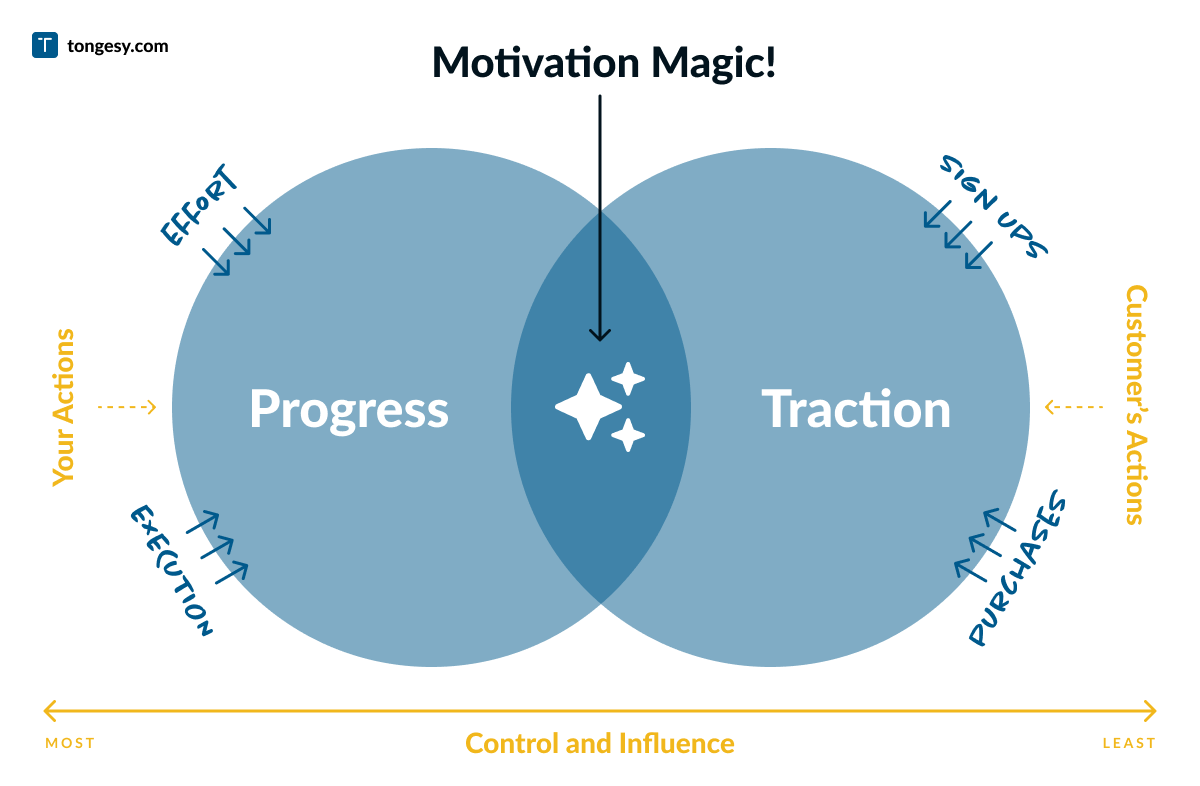
When you begin a startup, all you can focus on is progress. The things you can control. Think of a fire; progress is the kindling and twigs. Traction is the 100x multiplier. It’s the force of nature. The oxygen that brings the fire to life and turns it into an unstoppable, raging furnace.
When progress and traction combine, a startup flows. Motivation abounds. Work feels effortless, and success feels inevitable.
It's magic.
As Paul Graham aptly wrote:
“Startups rarely die in mid keystroke. So keep typing!”